
A long layover in Doha, a thirteen-year-old who’d never met a banana split, and the strange civic reverence the Gulf reserves for a French handbag.
There is a special category of fatigue that arrives somewhere around the seventh hour of a delayed connection, and I was deep inside it. My flight had quietly slid most of the way around the clock, my phone had given up, and my thirteen-year-old daughter had reached the stage of tiredness where everything is either hilarious or a catastrophe, often within the same sentence. We needed to eat. More to the point, we needed somewhere that looked like it wanted us there.
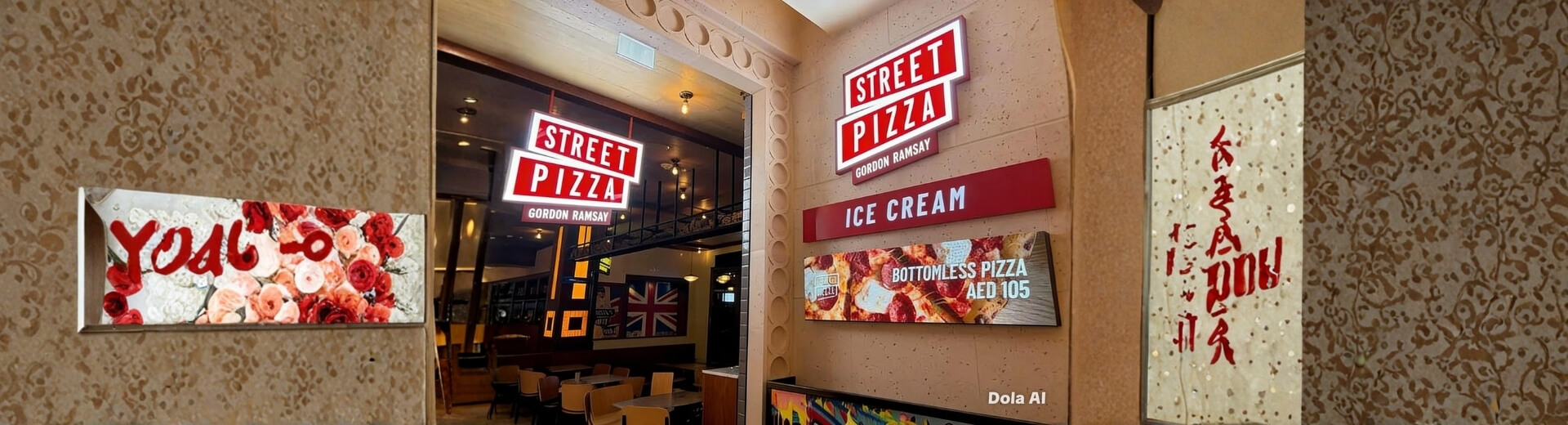
Which is how, at an hour when most of the world has the good sense to be asleep, we ended up at the Gordon Ramsay pizza place inside Hamad International — and how I learned that you can be charmed by an airport against your better judgement.
The pizza, when it came, was the genuine article. Not the gummy, reheated disc you brace for in a terminal, but something that tasted like the street pizza of Naples — blistered crust, a proper char, the cheese pooling rather than congealing. What it lacked was the chaos that usually comes with it. Napoli is a city that lives outdoors, in the street rather than the house, all scooters and shouting and someone’s grandmother conducting an argument across a laneway while your slice is folded into your hand. Here, the same pizza arrived in a room that looked, of all things, like an American diner: bright, orderly, booths and chrome and a kind of wholesome cheerfulness that felt several time zones away from the back streets it was imitating. The flavour of Naples, the temperament of a Midwestern milk bar.
There was one small piece of theatre I’ve not seen anywhere else. Before they’d cook for us, they asked to see our boarding passes. Not to verify some loyalty scheme or upsell a lounge — simply to check how long we had, so they wouldn’t hand us a half-eaten margherita and then watch us sprint for a gate. A pizza, it turns out, can be timed to a departure. I found this oddly moving at three in the morning, this quiet calculation of how much pizza a person can responsibly enjoy before boarding.
But the real revelation was the banana split.

I should explain that my daughter had never seen one. To a thirteen-year-old raised on a diet of whatever’s trending on a phone, the arrival of this object — the long boat-shaped dish, the split banana, the three scoops in their primary colours, the syrup and the absurd flourish of cream — landed like a relic from a civilisation she’d only heard rumours about. She looked at it the way you might look at a gramophone, or a payphone, or your father attempting to fold a paper map. “People used to eat this?” she asked, with the wonder of an archaeologist. People did. People still do, if they’re lucky enough to find one at the bottom of the world’s most over-achieving airport at an ungodly hour. We ate the lot between us, and the catastrophe-or-hilarity pendulum swung firmly, gloriously, to hilarity for the rest of the night.
Properly fed, we wandered, and this is when you really notice the building. Hamad International doesn’t have a roof so much as a gesture — a vast undulating dome, the largest stainless-steel roof of its kind in the world, designed to evoke the dunes of the desert and the swell of the sea. Walk beneath it in the small hours, when the crowds have thinned and the light has gone soft, and it does something to your sense of scale. Panels of coloured glass shift the light into faint, dreamlike hues. You stop feeling like you’re waiting in a terminal and start feeling like you’re standing inside a piece of architecture that genuinely meant to impress you. It succeeds. It has the Skytrax trophies to prove it, having been voted the world’s best airport more times than seems quite fair to everyone else.
What you don’t feel, at any point, is the desert. Outside lies one of the harshest climates on earth; inside, not a grain of it reaches you. The whole building behaves like a sealed glass oasis — climate-controlled, luminous, humming with quiet life — and it put me in mind of the sanctuary that clever survivors might one day engineer in a world where the air outside had turned unbreathable. Not the grimy, neon-soaked version of that future we’ve been sold by the likes of Blade Runner or The Running Man, all rain and ruin and flickering signage, but a luxurious one: the apocalypse with a Michelin lounge and a tropical garden. Somebody, somewhere, decided that if we were going to wall ourselves off from a hostile sky, we may as well do it beautifully. On this, at least, they got it gloriously right.
And then there are the shops, which are a story all their own.
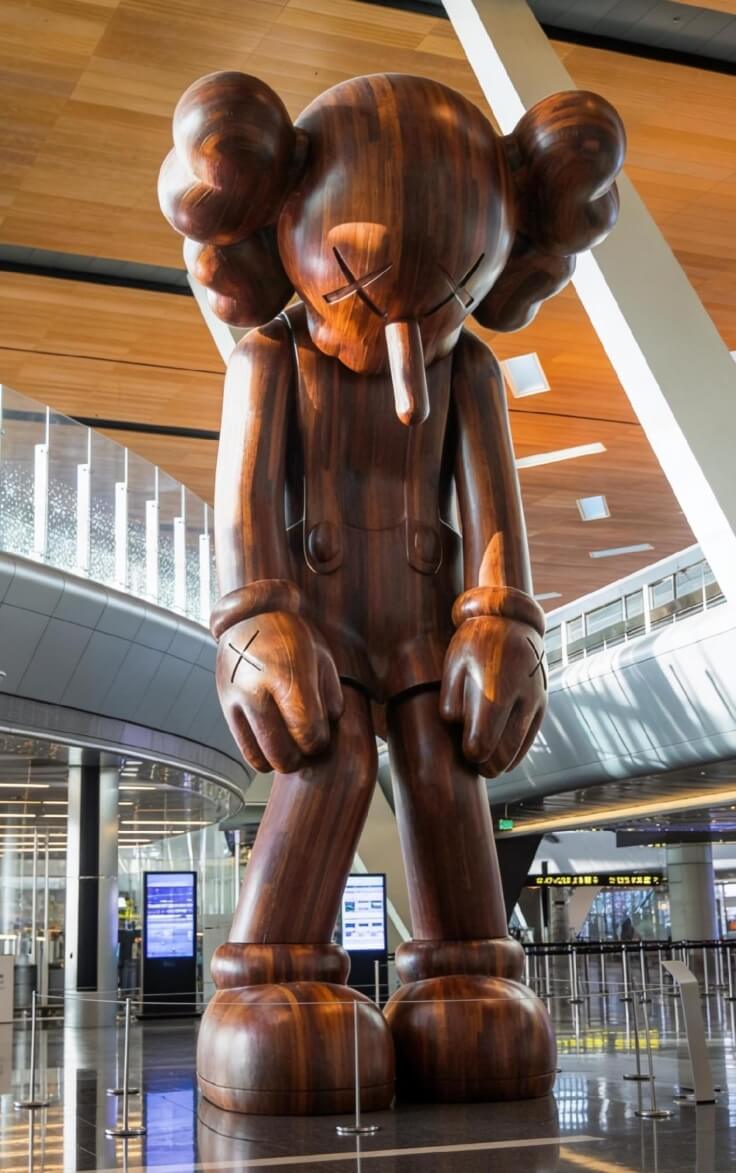
Once you’re through security, Hamad reveals its second identity: a high-end shopping district that wouldn’t disgrace Bond Street, except this one is airside and never closes. Harrods is here. So are Tiffany, Burberry, Hermès, Gucci, Bulgari and an Armani that runs the world’s first Armani restaurant inside an airport. There’s a Dior spa — again, a world first — where you can have a facial and be handed plush slippers between flights. And presiding over the South Plaza, planted right beside the airport’s beloved giant Lamp Bear (roughly 7 metres tall) sits an enormous Louis Vuitton boutique, complete with a life-size figure of the maison’s mascot keeping watch over the leather goods like a benevolent ghost.
What strikes you, as an Australian shuffling past in a creased shirt and the runners I’d been living in for twenty hours, is how much these names seem to mean here. Back home we treat luxury labels with a certain studied indifference — a logo is a logo, mate, and you’ll have spilled flat white on it by Tuesday. In the Gulf, the great European houses are accorded something closer to civic reverence: not just sold but enshrined, given their own pavilions and mascots and Michelin-starred lounges, elevated to a status somewhere between retail and monument. I watched travellers photograph the Louis Vuitton storefront with the devotion most people reserve for cathedrals, and I felt the pleasant vertigo of realising that a thing I’d always shrugged at could be, to someone else, a genuine object of wonder. Travel does this. It holds up a mirror and gently points out that your indifference is not universal — that one person’s overpriced handbag is another’s small, beautiful pilgrimage.
There’s plenty more to find if your delay stretches on. The Orchard, a six-thousand-square-metre indoor tropical garden in the northern end, offers three hundred trees and a hush you wouldn’t think possible in a transit hub. There are quiet rooms, a swimming pool, a playground for the smaller and crankier among us. My practical advice, offered as a friend who has now done the hard yards: the pizza place runs around the clock, so save it for the dead hours when you’ll have the room and the staff’s full attention; give yourself time to walk the length of the place, because the building rewards wandering far more than it rewards sitting at your gate; and if you spot a banana split on any menu, order it, if only to watch a teenager discover that the past occasionally got dessert exactly right.
We left as the dome began to fill with morning light. So here’s what I keep turning over. We spend so much of travel trying to get somewhere else — and yet one part of this trip we’ll all remember happened in the place we were only ever meant to pass through. What if the layover isn’t the price of the journey, but quietly, occasionally, the memorable bit of it?