Content warning: This article recounts first-hand experiences of wartime violence, including executions, the threatened massacre of civilians and children, and implied threats of sexual violence. Some readers may find it distressing.
We heard them before we saw them.
That sound. The distinctive pattering of rubber boots on hard ground is something I have never been able to forget, even now, eight decades later. It is different to the thumping of leather boots, the sound of British soldiers, the sound of safety. This was something else entirely. Something that told your body, before your mind could catch up, that everything was about to change.
It was the morning of 19 December 1941. My twelfth birthday.
From the verandah of our unit we watched them come. Japanese soldiers running up the hill towards our building, rifles fixed with bayonets, moving with terrifying purpose through the streets below. My mother, my little sister Dolores, two young Russian sailors named Boris and Igor, and me. We stood there in the cold winter air and watched the world end.
I did something foolish. Curiosity has always been my undoing. I went to a window at the back of our unit and opened it, it creaked loudly, and put my head out to see what was happening below. The gutters were running with water mixed with what looked like blood. And then I looked down and locked eyes with a Japanese soldier standing directly below me. My heart stopped. I may have screamed. My mother pulled me inside and scolded me.
She knew. Even then, she knew what was coming.
I watched her scrub the makeup off her face and dishevel her always neatly groomed hair. She then rubbed a dirty cloth on all of our faces and placed tin helmets over Dolores’s, and my head. I was baffled at the time. Only later did I understand she was trying to make us as urchinlike and unappealing as possible, to strip us of our femininity and grace, because the alternative was something she could not allow herself to name aloud to her daughters.
“It will be quicker that way and not hurt,” she said quietly. I was twelve years old, sitting on cold ground, holding my mother’s hand, waiting to be shot.
A COLONY BUILT ON FALSE CONFIDENCE
To understand how we came to be cowering in that unit, hiding behind tin helmets on my twelfth birthday, you need to understand what Hong Kong was in those years before the war, and how catastrophically the people in charge had miscalculated.
I had grown up on Hong Kong Island, a British colony, the daughter of a Cockney soldier named Tom Bonner who had been stationed in Hong Kong with the East Surrey Regiment in the early 1920s and never left, and a fiery, beautiful Spanish-Panamanian woman named Raquel, who had grown up in Kowloon. We were not wealthy. Dolores and me slept on camphor wood chests covered with thin mattresses. But Hong Kong was alive and electric and full of possibility, and I attended the French Convent School at Causeway Bay, where I learned Chinese and Spanish alongside my English, and taught myself to sketch and paint.
By late 1941, the Imperial Japanese Army had been massing on the border of the New Territories. On the 8th of December 1941, the same day as the attack on Pearl Harbour, just hours apart, 30,000 Japanese troops crossed into Hong Kong. The British plan had been to hold them for perhaps three weeks. They barely lasted one.
MY FATHER’S LAST WORDS
Although my father had now left the army he was called back into action. He said goodbye to us in the front garden. He was in his camel-coloured Hong Kong Volunteer Defence Corps (HKVDC) uniform. He hugged each of us. “Look after your mother,” he said to me. I thought it was a very strange thing to say. Mothers were supposed to look after children. But I promised him I would.
I never saw him again.
THE MACHINE GUN ON MY BIRTHDAY
On the morning of our capture, the soldier burst through our door with his bayonet fixed to his rifle, shouting in Japanese, gesturing furiously for Dolores and I to remove our helmets. Terrified, we obeyed. My golden hair fell loose.
He did not harm us. Instead, he herded us downstairs and out into the freezing air. We were marched down a rocky hillside path, and halfway down, a body lay across the path. A big Indian soldier, shot through the chest, his brown eyes staring at the sky. Dolores and me had trouble clambering over him. It was the first dead body I had ever seen, but unfortunately, not my last.
At the bottom, a crowd of mostly women and children was being detained. Across the main road, Japanese soldiers had mounted a machine gun and trained it directly at us. We were terrified, and it showed. Other Japanese soldiers milled around watching us and laughing.
Then, after several hours of goading us, we heard the Japanese machine gunner actually cock the machine gun. Everyone in that crowd knew they were about to die. All around us, mothers were hiding their children behind them. Cowering, screaming, crying.
Everyone that was, except my mother. She sat Dolores and me down at the front of the crowd, directly in front of the machine gun position, and demanded we do not get behind her or in front of each other. She asked each of us to hold her hand exposing us completely to the danger. “It will be quicker this way. It won’t hurt,” she said quietly. I was twelve years old, sitting on cold ground, holding my mother’s hand, waiting to be shot.
I had my eyes closed. We waited and waited. And waited some more. Nothing happened. The machine gun was never fired. Miraculously, a Japanese cavalry officer on a beautiful white horse arrived and stopped the massacre. It seemed like a dream. It seemed like it was too good to be true. I wondered if I had crossed over and missed the sudden impact of the bullets. I could not tell. What would soon become clear is that we were going to live, at least a little longer, as “guests” of the Japanese empire.
NEARLY FOUR YEARS BEHIND BARBED WIRE
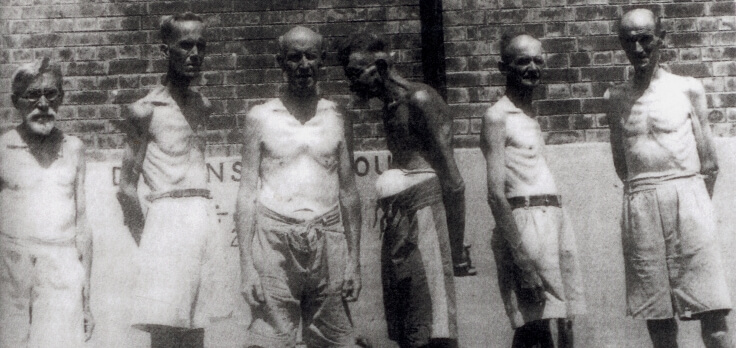
What followed was nearly four years of imprisonment at Stanley Internment Camp, on the south-eastern peninsula of Hong Kong Island, enclosed by barbed wire. About 3,000 of us, mostly British, but also Canadians, Dutch, Russians, and a few Americans. Our basic ration was one pound of rice per person per day, supplemented with whatever rotting vegetables the Japanese chose to provide. Historians have estimated that we received around 1,400 calories daily. An active adult needs at least twice that. I was always famished. Always.
We slept on wooden planks infested with bugs. We burned a string dipped in peanut oil for light. We used cardboard when the soles of our shoes wore out. I learned to scrape between my teeth with a fish bone dipped in water because there was no toothpaste.
But I was twelve years old, and young bodies are resilient, and I was stubborn in ways that perhaps saved me. While other children attended school in the makeshift classrooms, I ran free through the camp, scavenging for firewood or anything that could be eaten. From the earliest weeks, I roamed the grounds with a hessian gunny sack, scouring every corner for anything that would burn: pine cones shaken from branches I climbed bare-footed, dried grass pulled from near the barbed wire perimeter, twigs, weeds, anything at all that might coax a flame beneath our cooking pot. I was not above begging. I once told a man in the communal kitchen that the fish bones he was about to discard were for our cat.
They went straight into my mother’s soup pot. Bill and I created a small vegetable garden on a sloping patch of ground behind C Block, fertilising the soil with raw sewerage piped directly from the building; the smell was something between black tar and the end of the world, but it worked. We grew tomatoes from seeds separated from a tin, tended them daily as if they were made of gold, and eventually traded the surplus to wealthier internees in the Married Quarters for sardines. I learned to read guards the way a sailor reads weather, which ones might look away, which ones might smile back at a twelve-year-old girl carrying a sack. I discovered that a small, fair-haired girl could go places and ask things that would earn a grown British man a beating. You adapted, or you didn’t. I adapted. Once, a guard handed me a jar of Bovril from his own supplies. I held it tight and ran like hell. In some ways, I was in my element.
HORRORS THAT CANNOT BE UNSEEN
However, I was not free of horror. I witnessed things no child should see. Many of the male prisoners were beaten mercilessly at different times for no apparent reason apart from showing them who was boss. The Japanese would use sticks or sometimes the buckle of a belt. We used to tend to their injuries in the evenings. At times it got worse still. One afternoon, from a hillside near the barbed wire, I saw a British man finish digging a trench, step out of it, and kneel before it with his head bowed. A Japanese soldier raised a Samurai sword. I closed my eyes at the last moment, but I heard the thump. I have never been able to look at a large knife without flinching since.
My father, I learned much later, had had a similar fate. He was killed on the 22nd of December 1941, three days after my birthday. He had served with distinction to the end. We had heard stories that he and others had run out of ammunition and had taken to throwing stones at the advancing Japanese soldiers. Their defence had been stoic, but they never stood a chance.
“Look after your mother,” he said. I promised him I would. I never saw him again.
SURVIVAL AT STANLEY CAMP
Not all the guards were brutes, and I learned that early. Some were Formosan-Chinese, conscripted into Japanese service against their own inclinations, and a handful seemed almost embarrassed by what they were required to do. As the war ground on and the tide began to turn, something shifted in the atmosphere of the camp. Guards who had once strutted became quieter. Small kindnesses began to appear from nowhere, a request to visit the beach granted without the usual theatre of bureaucracy, a blind eye turned to a girl scavenging too close to the wire. One guard had always been kind to us. He took to visiting our unit in the evenings, sitting with us and talking in Chinese about his family, his home, his loneliness. He seemed lost. I felt genuinely sorry for him, which was a strange thing to feel about one of your captors, but there it was. He sometimes brought a spare blanket, or snuck a small packet of dried biscuits under his helmet.
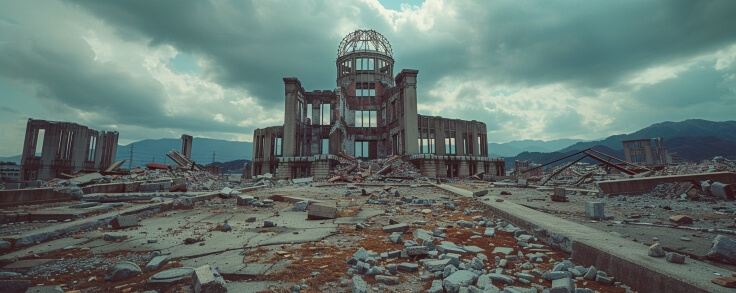
Then came the night everything changed. That same guard arrived at our unit in a terrible state. He was absolutely beside himself, shaking, weeping uncontrollably, words pouring out of him in a torrent we could barely follow. As best we could understand, his family had been in Hiroshima, and everyone he knew was now dead. He was inconsolable. We would later learn that atomic bombs dropped on Hiroshima and Nagasaki, had effectively ended the war.
And there we were, the prisoners, sitting with this broken man, trying to offer comfort to the person who had held us captive for years. My mother put her hand on his arm. I did not know what to say, so I said nothing. The war was over, though we did not yet know it officially. And in that strange, suspended moment, the line between captor and captive simply dissolved. We were all just people, sitting in the dark, trying to make sense of a world that had lost its mind.
LIBERATION, AND SHOES
Liberation came on the 30th of August 1945, when sixty-one Allied ships arrived in Victoria Harbour. British and Australian soldiers came through the gates and they looked impossibly strong and healthy, their uniforms clean and pressed. We were skeletal, our clothes in rags, many of us barefoot. When a British official asked what I wanted most, I said immediately: “Shoes.”
They gave me a good, sturdy pair.
LIFE NOW, AT 96
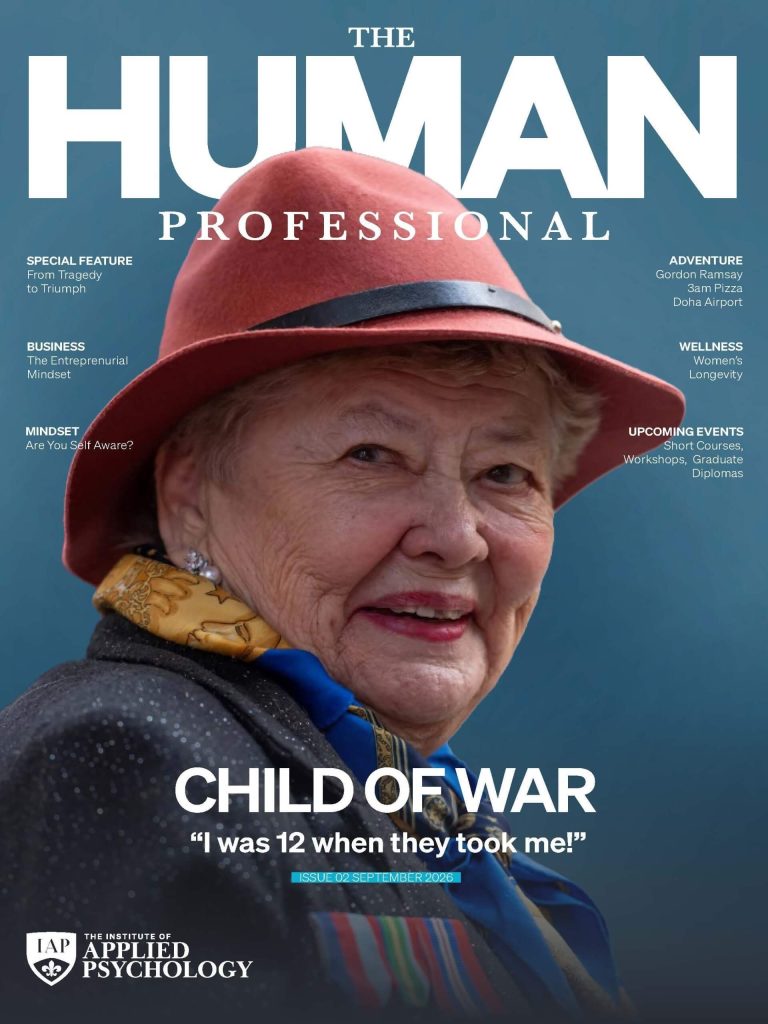
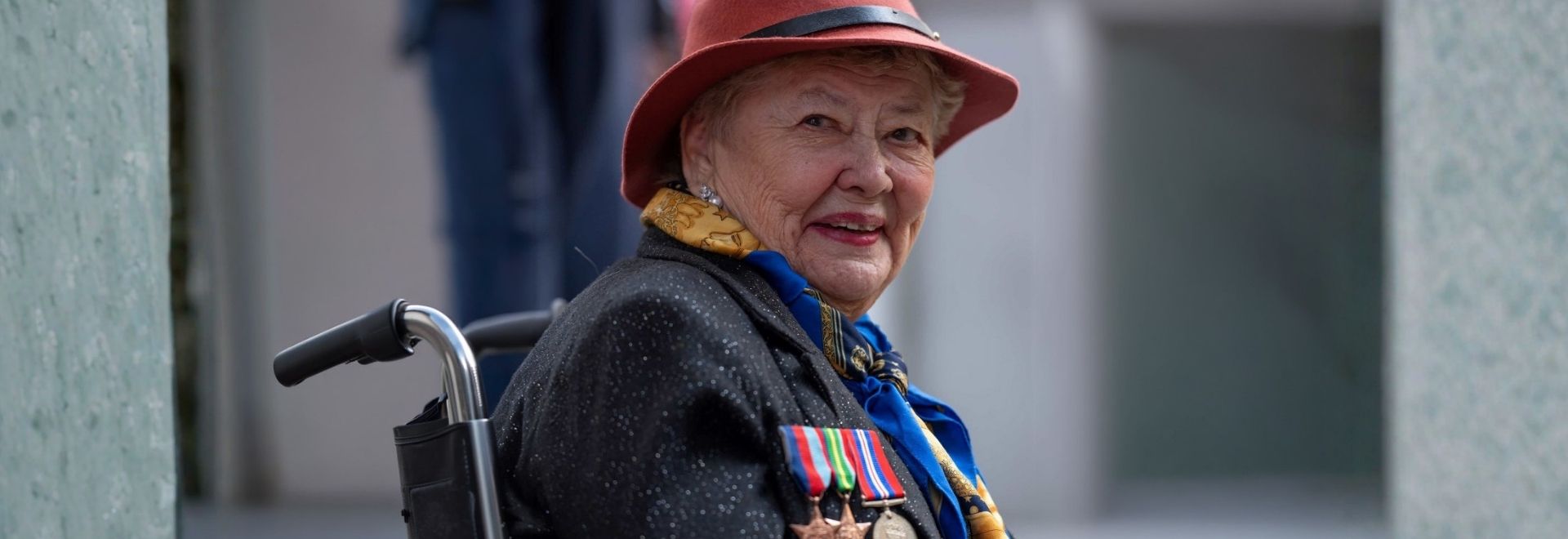
I am 96 years old now, living in Sydney. I think about those years often, though not always with grief. I think about them most keenly at Anzac Day, at the march, watching the veterans and their descendants pass, knowing that so few of us who actually lived through that period remain. I march (when I say march, I mean my granddaughter Ella pushes my wheelchair) proudly wearing my father’s medals.
What strikes me now is how utterly different the world was. The casual cruelties of colonialism, the White Australia Policy that would have barred my own Spanish-heritage mother from refuge, the class snobbery of British expatriates who expected Chinese people to walk behind them on the footpath. That world is gone, and I do not mourn it.
What I do carry is the knowledge of what human beings are capable of, in both directions. I saw the worst, and I saw the best.
I have been frugal all my life, and resourceful. Stanley Camp gave me that, if “gave” is the right word.
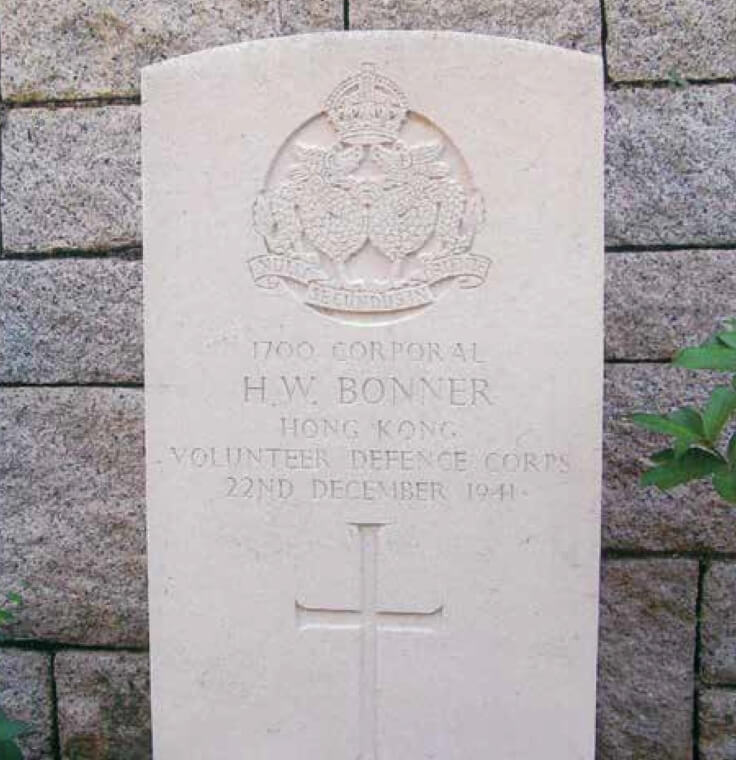
My father is buried in Stanley Military Cemetery. In 2005, I visited his grave with my children Gordon and Karen. I was told not to take photographs. I disobeyed.
Some habits from childhood die hard.
Purchase the book:
The full account of my wartime experiences has been published in Child of War: My Teenage Years at Stanley Internment Camp. These memoirs, woven together, are the closest thing I can offer to the truth of what happened in that place. Memory is imperfect. But some things, you do not forget.
Julia Young passed away peacefully in her sleep on 30 August 2026, aged 96. This piece, drawn from her memoir Child of War, was one of the last things she shared, and we pass it on with great care and gratitude. Julia was the much-loved mother of IAP founder Gordon Young. Our thoughts are with Gordon, his family and all who loved her.